
New Zealand's World Cup Opener in Doubt as Iran Signals Withdrawal from Tournament
All Whites' Group G fixture against Iran threatened after Iranian sports minister announces potential boycott over U.S. hosting; FIFA faces geopolitical crisis three months before kickoff.
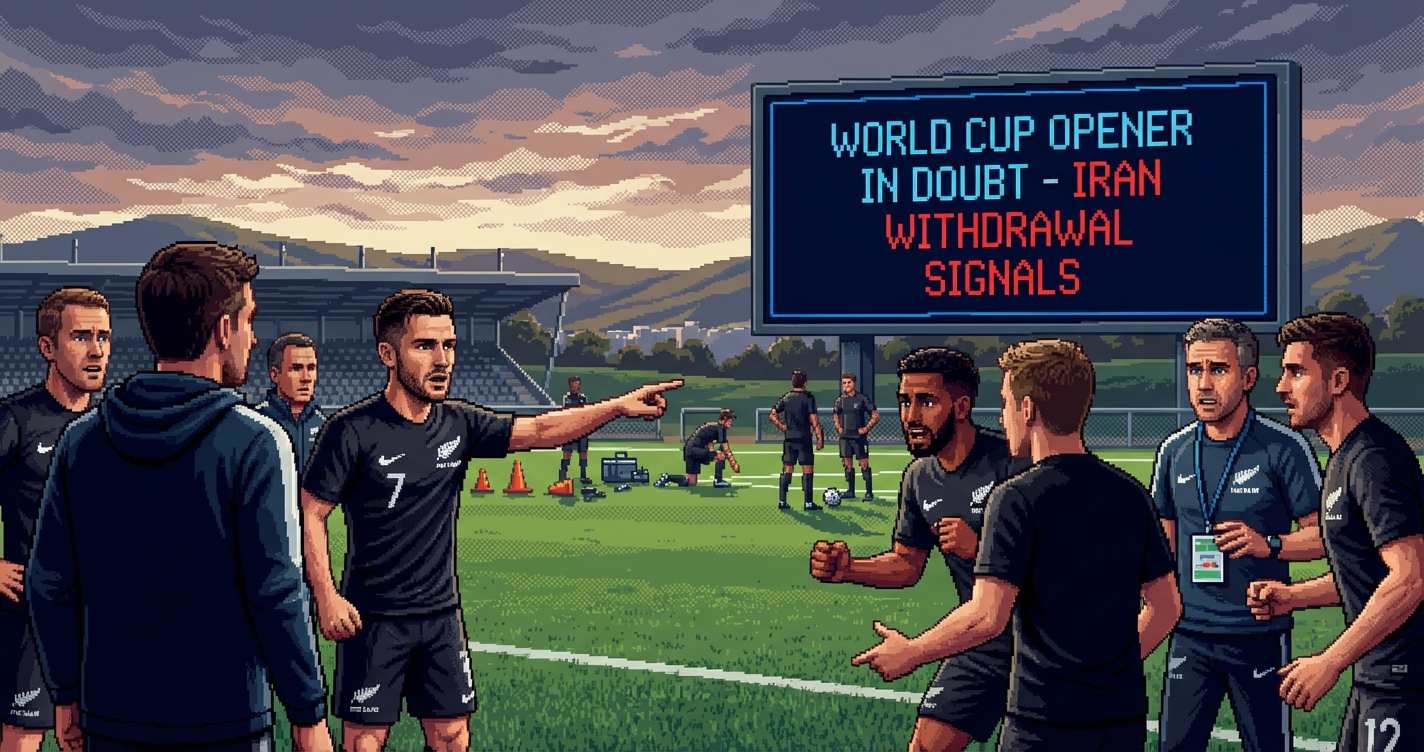
New Zealand's opening match at the 2026 FIFA World Cup has been thrown into serious doubt after Iran's government signaled the national team will not participate in the tournament. The All Whites' Group G fixture against Iran—scheduled as one of their three crucial group stage matches—now faces cancellation just three months before the tournament begins, creating a scheduling crisis for FIFA and uncertainty for a New Zealand side that qualified through Oceania's rigorous pathway.
Friends of Football reported the stunning development on March 12: "New Zealand's opening match at the 2026 FIFA Men's World Cup is in serious doubt after Iran's government signalled the national team will not take part in the tournament. Iran's sports minister Ahmad Donyamali said his country could not participate in a competition staged partly in the United States amid escalating conflict in the Middle East." The minister's statement to Iran's state television channel was unequivocal: "Considering that this corrupt regime has assassinated our leader, under no circumstances can we participate in the World Cup."
The potential withdrawal creates unprecedented complications for Group G, which pairs New Zealand with Belgium, Egypt, and Iran. If Iran formally withdraws, FIFA faces difficult questions about competitive integrity—whether to replace Iran with another qualified team, redistribute fixtures, or proceed with a three-team group that fundamentally alters qualification mathematics. For New Zealand, losing a fixture against Asian opposition that many analysts considered their best chance for three points would dramatically change their advancement calculus in a group featuring European powerhouse Belgium.
New Zealand qualified for the 2026 World Cup after defeating New Caledonia in the OFC final at Eden Park in March 2025. A-Leagues.com.au documented that achievement: "It was a nervy night at Eden Park but after Boxall's opener, the heavily-fancied hosts eased to victory as their spot at the 2026 World Cup was confirmed." The qualification represented redemption for a program that missed the 2022 tournament despite competitive performances in previous World Cups. Now that achievement faces diminishment if geopolitical forces beyond their control eliminate one-third of their group stage opposition.
Iran's threatened withdrawal stems from escalating Middle East tensions and specifically references alleged U.S. involvement in regional conflicts. The decision represents government intervention into sport—a scenario that typically triggers FIFA sanctions under the organization's rules prohibiting political interference in football federations. However, when governments simply refuse to allow teams to travel rather than interfering with federation governance, FIFA's enforcement options become limited to accepting the withdrawal and managing tournament logistics.
For New Zealand head coach Darren Bazely, the uncertainty complicates preparation for a tournament where the All Whites face enormous challenges regardless of Iran's participation. NZ Football confirmed Group G's composition: "New Zealand has drawn Belgium, Egypt, and IR Iran in Group G." Belgium enters as one of Europe's most talented squads despite questions about their aging golden generation. Egypt brings African championship pedigree and Mohamed Salah's world-class attacking threat. Iran, when healthy and participating, represents Asian football's defensive discipline and organizational strength that has frustrated superior opponents at previous World Cups.
The geopolitical crisis extends beyond New Zealand's immediate concerns. If Iran withdraws, it would mark the first time a qualified team has boycotted the World Cup for political reasons in the modern era—precedent that could embolden other nations facing domestic pressure to make similar decisions in future tournaments. FIFA has navigated team withdrawals before—Russia's exclusion from 2022 qualifying following the Ukraine invasion created playoff complications—but never has a qualified team announced withdrawal so close to tournament kickoff over host nation politics.
For New Zealand, the situation creates strategic uncertainty that coaching staff cannot resolve through preparation. The All Whites' World Cup planning has assumed three group matches against known opponents with identifiable tactical approaches. If Iran withdraws, does FIFA reschedule to maintain competitive balance? Do remaining Group G teams face altered rest periods? Does New Zealand's advancement probability improve or worsen with a three-team group? These questions lack answers until Iran's federation formally communicates final intentions and FIFA announces contingency plans. Until then, the All Whites prepare for a World Cup opener that may never occur against opposition that might not arrive.